Saturday, October 29, 2011

Gefilte Fish


The mother of one of my students invited me to her home for Shabbat dinner. As the six year old son passed the gefilte fish across the table to his grandma, I realized that somehow, in this Christian nation, I have felt as – if not more – connected to my Jewish roots than living in New Jersey or New York, where are there are more Jews than anywhere in the world, second only to Israel. How is this possible?

First, let’s look at Costa Rica’s relationship with Israel. Costa Rica was the first country to establish their embassy in Jerusalem, unlike most countries, where their embassies are in Tel Aviv so as not to offend the Palestinians’ claim on the religious city. This is a statement in itself and it stems from a very unique commonality between two nations – they are (or were) the only democracies in a region surrounded by military regimes.

What role do Jews play in Costa Rica? Well, there’s Luis Liberman Ginsburg. Who? He’s only the vice president of Costa Rica.

This country is a hospitable country to foreigners, making Costa Rica a place where Jews cannot only practice their religion, but thrive in an active Jewish community and in the community at large. Part of the reason that I’ve felt a strong connection to Judaism here is because it’s something I’m familiar with in an unfamiliar land. But I believe that it’s more than that. It stems from the fact that the Jewish community here is not only successful, but is very tight-knit. It seems like Jews here do not marry outside their faith: in every Jewish gathering I’ve attended, there has also been someone playing the matchmaker. Also the day after I informed my student that I was Jewish, he handed me his cell phone, saying, “it’s my mom”, and she extended an invitation to her home for Shabbat dinner. Would that have happened in New Jersey? Probably not. Not when there are 500,000 Jews as compared to 3500.

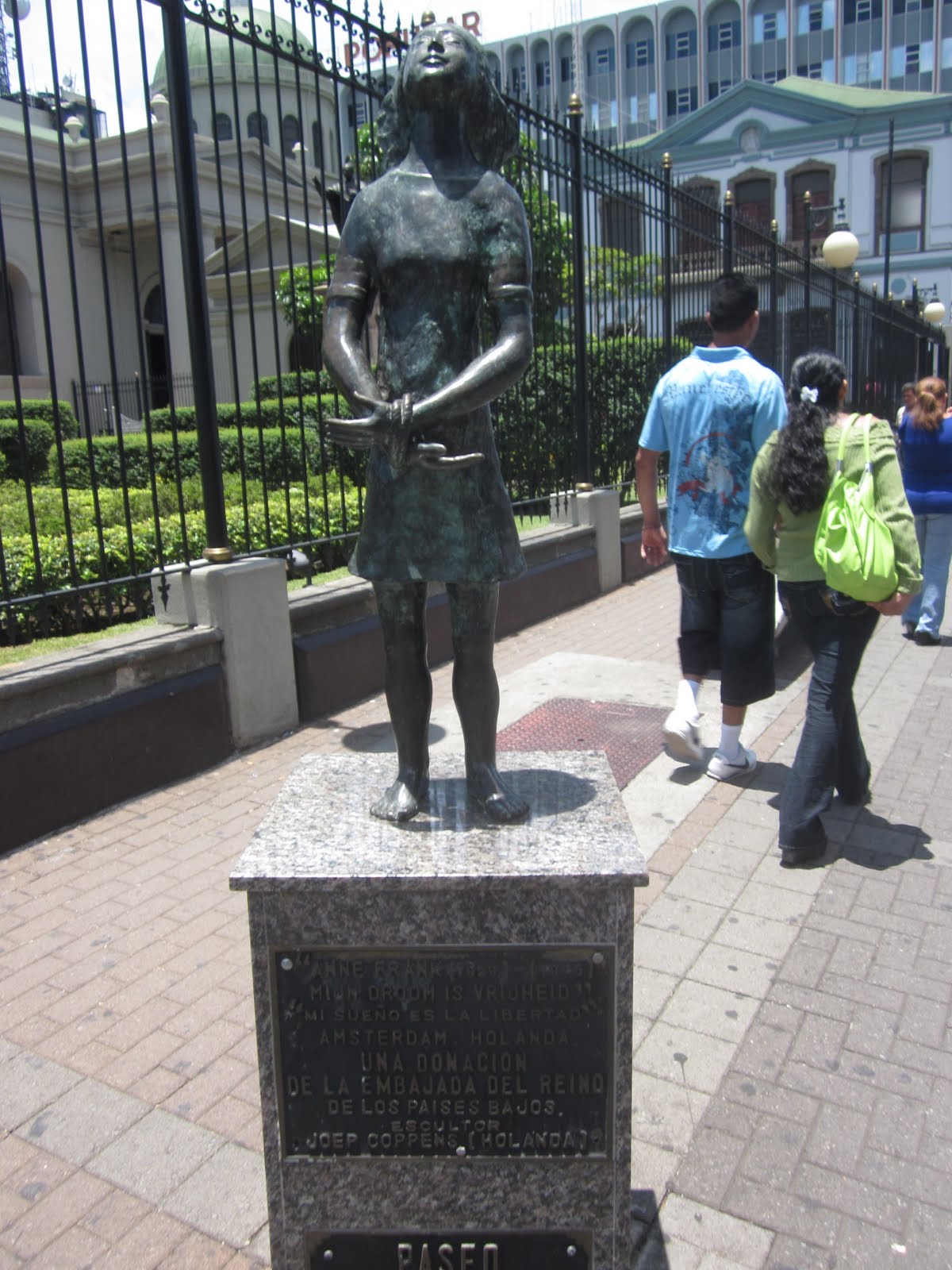
Yet it’s more than sheer numbers. In Japan, where there are 2000 Jews, I didn’t find the Jewish community to be as welcoming nor as active as in Costa Rica. This may be in part because the Costa Rican Jews have a rich history. Most of the oldest Jews here immigrated in the 20s and 30s from the same village – a shtetel in Poland called Yelechov. There are even 200 holocaust survivors in Costa Rica. In the center of San Jose is a statue of Anne Frank (picture above).

The Jewish community here is unlike any other Jewish community I have ever come across in my travels. Despite being accepting to Jews, Costa Rica is still a Christian dominated land, and so it’s unlikely you’ll come across a kosher restaurant or a mikvah. The Jewish community has responded to this by defining its Jewish identity in unique ways, at least from a New Jersey Jew’s perspective. My student’s family is part of the orthodox community here. Having attended Shabbat services on Friday night (as they do every week) at a synagogue where men and women are separate, they returned to the grandmother’s home to meet me for dinner…by car. They then served the vegetarian (that’s me, by the way) cheese lasagna while everyone else ate chicken. They may even be working today - one of my Jewish friends here told me that most Jewish businesses stay open on Shabbat. What I’ve gathered from all this is that there seems to be a distinction here between inside and outside the synagogue.

Judaism is not only a religion, but a culture and a race, a small minority with major success, a people of nearly 6000 years (the oldest existing religion in the world) who have survived countless persecutions. As my student’s family drove me home after Shabbat dinner, I told them that it was nice to be among Jews. “There’s a unique connection among us,” the mother responded, “which nobody else understands.”

Sunday, October 23, 2011

The Adventure to Guatemala: Part 2


Cesar pulled the car over and we examined the tires in the storm. The front left and the back left were flat. We changed the front tire, which was completely dead, but we only had one spare. In order to secure a safe spot on the side of the road, we had to turn around and drive against traffic. The only lights visible in the night were those of the oncoming cars. We pulled over to the side and Cesar rang the doorbells of nearby homes to no avail. I noticed he was wincing in pain - his forefinger had turned green. He injured it while changing the tire.

Cesar called for help from Guatemala City - an hour away - and we waited. Mima sat quietly and the girls typed away on their phones while Cesar soaked his finger in the rain. Three hours later, Cesar's brother showed up with a truck, who knows where he got it from (there's no AAA in Central America). Cesar drove the van onto the back of the truck and I gazed through a misty windshield as we were driven back to Cesar's home, lost in a state of exhaustion and surreal silence.

We were the lucky ones. The next morning I awoke to a television report about landslides, "rumbas", throughout the country. The road to Antigua was closed; rescue teams were sent out, searching for people buried beneath the earth. Nine people were reported dead.

What I found most striking of all from this experience was the way the Palacios responded to the situation. Not a single complaint was made by any of the teenage girls. Not once did Mima express fear or incertitude. Cesar took charge, understanding his duty to his family, and seemed unaffected by his wife and daughters' gentle laughter when he wrapped up his finger in a makeshift splint of band-aids. I taught the family the word game "Ghost" and they demonstrated the English they had learned at their bilingual school with giggles and squeaky voices.

Things move at a slower pace down here than most places - let alone the New York area. There is less stress and worry - at least on the outside. Maybe having gone through a 36 year civil war, countless corrupt governments, and little in the way of human rights, the people of Guatemala are able to let a small crisis (or inconvenience, depending on how you look at it) glide down their backs like the falling rain. All people encounter tragedies in their lives of some form or another. Perhaps it's how we respond in the face of these events that really defines us.

Wednesday, October 19, 2011

The Adventure to Guatemala: Part 1


As I entered the terminal at La Aurora International Airport, I studied the faces of men and women from a different world. This was my first flight within Central America and I didn't see a single gringo lining up to get his or her ticket checked before stepping onto the plane. Guatemala was the first country I knew I would travel to before I even mored to Costa Rica. I wanted to see where Marleny, my family's housekeeper since I was three, grew up; I wanted to meet her family. I wanted to experience Central America.

In the last decade, only 5% of the murders in Guatemala were prosecuted. The number of kidnappings have quintupled; annual murder rates have risen from 2904 to 6498. Despite new penalties for femicide, they are considered useless in a country where so many murders go unsolved.

These dangers stem from poverty, which is impossible not to notice if you look out the airplane window as the plane hits the runaway in Guatemala City. Between the forests and rolling hills are dilapidated homes as far as the eye can see.

The first thing you can't help but notice when you step out of the airport are the Mayans, Nearly half the population consists of "indigenas" clad in traditional garb - striped skirts, ornate blouses, and long, beaded necklaces for the women with braided hair, cowboy-like sombreros for the men. The Mayans may be the poorest people in the country, but they possess an incredible richness in history and culture. It was to an ancient city, Antigua, where I was headed, to which my friend, Reuben, who traveled the slither of land from Costa Rica to Guatemala, described as, "the Jerusalem of Costa Rica".

Marleny's niece, her husband, and their three daughters, ages 15, 17, and 19, picked me up at the airport. Cesar, who has a note written by one of his daughters above the desk in his office that states, "el mejor papi del mundo", rented a van just to have enough room for me and my luggage (which was only a backpack).

After lunch at a nearby mall, we set off for Antigua. Not only does Antigua retain its beauty through colonial building and ancient ruins, but it is surrounded by 3 volcanoes. But I only knew of them through books and photographs. By the time we left lunch, a deep fog had taken over the sky, and it started to rain. Hard.

In the midst of a thunderstorm, Cesar Palacio took the wheel, dodging potholes left and right, on the road to Antigua. The three daughters were in the back , playing with their blackberries, and Mirna was silently observing. When our tires hit the cobblestone streets, I could tell, despite the horrid weather, that Antigua was a special place. In fact, Antigua looked pretty in the rain, heavy droplets falling in front of the lights of the Catedral de Santiago. I studied the local dwellings, built with mud, stones, and wooden poles "bajareque" style, through the blurred car window. Perhaps this was the way Antigua should be seen - the city has stood the test of time, surviving earthquakes, volcanic eruptions, and has retained its traditional charm, not unlike that of Kyoto, Japan.

All was fine as we ran back into the van and left the ancient city. But on the road back to Guatemala City, Cesar was unable to avoid one of the many potholes. One was all it took.

Part 2 soon to come...

Monday, October 10, 2011

Yom Kippur in Costa Rica

There are four synagogues in Costa Rica: an orthodox and Sephardic temple in the Jewish area of Pavas, a chabad, and one in the outskirts of San Jose, which a member described as “reform or conservative – whichever way you look at it.” Costa Rica is nearly 85% Christian (70% Roman Catholic and 14% Evangelical Protestant). There are a total 2500 Jews.

B’nai Israel, the “whichever way you look at it” synagogue, was my shul of choice. I took a long taxi ride through San Jose traffic to a destination I feared the driver had no idea how to find, let alone what a "sinagoga" was (my explanation: Una iglesia para judio!). The sun set and it was dark. But as I scanned the buildings out the window, I spotted the Magen David (Jewish star) in the window and shouted, “Esso!”

The services were conducted in English, Spanish, and Hebrew. I felt strangely drawn to the Spanish prayers, to chanting aloud in the native tongue. When the service ended, I kibitzed with the congregants. They were from all over the world: Spain, Mexico, USA, Colombia. The rabbis were a couple from Argentina.

Although I wasn’t spending the holiest of days with my family, I was glad to experience Yom Kippur in Latin America. It felt good to be part of a larger community. There I was, saying the same prayers as Jews around the world, atoning for my sins, fasting. It’s nice to know that almost anywhere I go in the world there will be a synagogue for me to go to, the Magen David proudly displayed. Now if only that were the case with a good bagel.

Friday, September 16, 2011

Final Thoughts on Fate

This is my third time in Costa Rica. The first was a trip with my family and the second a group tour when I was in high school. There was a rebellious side to me as a teenager - I lauded Catcher in the Rye, and opposed almost anything mainstream. I associated a lot of these ideas with music, hailing classic rock as the sole genre worth listening to and insisting that that pop had no value except as a drug of conformity.

It was on an organic farm in Costa Rica that I put Zeppelin II into my CD player for the first time, watching rain pound against the roof of my camping tent. The effect that album had on my rebel teenage spirit was immense: when I returned from the trip, I arrived at school with “Ramble On” blasting through open windows.

In college, I got into more current music, rap, modern rock, and eventually jazz. While my devotion to The Beatles, Rolling Stones, and The Who remained strong, Led Zeppelin loomed farther into the background. As the years passed, I listened to them less and less.

Two weeks after moving to Costa Rica, I scanned my iTunes list for something to listen to. I had forgotten about the night on the organic farm with Zeppelin in my ears. Yet that night, I chose Zeppelin II. But that wasn’t all. The strangest thing wasn’t that I happened to put on the same album I got into the last time I was here, but that I got the same feeling I had while listening to it. I was into it like I had been that rainy day…a decade ago. It was only later that I made the connection. As the lyrics go, “I’m goin’ round the world, on my way, I’ve been this way ten years to the day…”

Sunday, September 11, 2011

Journey into Nature Part 2: Is it fate?


As soon as I arrived in Costa Rica, there was talk about fate. Now I’ve never really been a believer in fate – I believe in choice and in God. In the recent months before coming here, I was becoming wary of making decisions. Maybe it was my future looming in the distance, but for whatever reason, I began taking a different approach for the small decisions: let fate handle it. And then suddenly, and completely unexpectedly, I ended up in Costa Rica.

When I first arrived here, Carlos told me the story about how the day he arrived in Costa Rica was the same day his wife's birthday (who is a Tica). Is that fate? My journey to Barva looking for the waterfall to no end, yet finding myself in the very festival I thought I was missing…is that fate? And why am in Costa Rica, anyway? Three weeks before landing at Juan Santamaria International Airport, feeling the humidity hit my cheeks, I never would have imagined myself living here.

With these thoughts circulating, I made a second attempt to escape the urban life and commune with nature. This time, I would head past Barva to San Jose de la Montana, which I was told, was a real mountain town, and was near the entrance of Barva Volcano. I didn’t know how long it would take to hike up to the peak of the volcano, or which path to take, all I knew was that I wanted to find a spot in the woods, eat a sandwich (I packed a PB&J with pretzels), and read my book (In Cold Blood).

I hopped on a bus, and when I arrived in San Jose de Montana, I got off at the very last stop, and asked the bus driver, “Donde esta la Montana?” Keep hiking up, he said, take a right, and a left, and then I’d reach the volcano. It sounded simple enough.

Simple, sure, but long and steep. I hiked up that road for four hours…and it felt fantastic. As I walked higher and higher, it became more rural and rural. I saw cows grazing on a cloudy field. Wet local cheeses for sale lying lonesome on a wooden table. A middle-aged man and woman igniting a fire with sticks along a stream. As I kept hiking, I entered into a white mist. It was gorgeous drifting through the trees that dotted the hills. But soon, I couldn’t see any trees. All I could see was white. I was in a cloud.

Fine, I thought, I could keep going all day – maybe I’d even reach the volcano. But then it started to rain.

I took shelter at a nearby restaurant – the first one I had seen for miles (or should I say kilometers). I had an umbrella but I didn’t bring my rainjacket, and I was getting cold. I knew then that I was done hiking for the day, even if I was just three kilometers from the entrance to the volcano. I had imagined the walk from the entrance to the base of the volcano to be a five-hour journey, but I’d find out later, it was only five kilometers away.

I sat down at the restaurant and was thrilled to see a cheese omelet on the menu. Cheese omelets here mean ham and cheese, so I tried to explain what I wanted to the waitress (no ham!), and a man came over asking if I needed help. I didn’t really, but I let him anyway. He said, “Welcome to Costa Rica!”, and sat back down with his family of four. When the omelet arrived, he came to my table again, and said, “Don’t worry, I already paid.”

I was wowed by this man’s generosity. Then as I began to walk back down, I debated whether I should try hitchhiking or not. On the one hand, it was pouring, but on the other, was it safe, in a country with metal bars and electric fences in front of homes? I finally got fed up with the rain, stuck out my thumb, and was picked up twice.

Although I didn’t reach the peak of Volcan Barva, it felt great to hike, and see rural parts of the country. And although I didn’t reach my goal – I never found that spot where I could sit down, eat my sandwich, and read – I discovered something more valuable. Maybe the generosity of the people I had met that day came from the fact that they were from the countryside, or maybe it was because they thought I was a tourist, and they wanted to make a good impression of their country. But still, what it showed to me, was that certain values have no bounds, and one of them, which makes humankind so great, is kindness.

Wednesday, September 7, 2011

Journey into Nature Part 1: Is it fate?

I wanted to escape the city and go into the mountains. I found on wikitravel a “gorgeous waterfall and swimming hall” in the “small and cute” town of Barva, which is just north of Heredia. None of the local Gringos or Ticos who I asked about the waterfall had ever heard of such a place, but that didn’t stop me from journeying into the unknown.

While on the bus, I reached for my guide book and read that Barva is known for the Feria de la Mascarada, where performers dress up in lavish costumes and wear huge masks (some of which weight up to 20 kg) of demons, devils….and local celebrities. The festival was on the upcoming Wednesday…I was three days too early.

I imagined Barva as a quiet village set under the shadow of Barva Volcano. But this was no mountain village. The main square was filled with people, out with family and friends, and vendors, selling churros and chop suey. I left the bus and read the directions, “Facing the church, walk left, then take your first left. Follow that road for a quarter of a mile…to the left will be a trail going down to the river.” I took the first left and walked down the road…

...as I walked, I came across a flat white building with music blasting from inside. I peeked my head in. There was a girl dancing, dressed in traditional garb, a white, green, and red plaited dress, in front of a screen that showed pictures of Jerusalem and had lyrics about Jesus. Everyone was chanting with incredible fervor, besides a detached teenage girl sneaking peeks at her cell phone. An old woman saw me and motioned for me to enter so I did, and I stood there and watched. I thought about my time at the discoteca and how dancing and singing was such a big part of the culture here…and I made the connection to religion. I suppose certain things are engrained in society and they're all interconnected. I thought about a night in Heredia when I heard blasting salsa music coming from a large hall and when I looked inside, I was surprised to see not the young students from the university nearby, but a crowd of old men and women, dancing their heads off. You’d never see that in the States, I thought, it’s not an integral part of our culture, something we learn as a child, and continue until we’re elderly, like dancing to a bolero, or bolting out tunes at karaoke, or juggling a soccer ball with our feet.

I continued down the road. But I saw no trail, river, just houses, and cars speeding by me at dangerous speeds. So I retraced my steps and took the second left instead of the first. This time I passed a river, and thought I was going the right way…but never saw a trail. By this point, I had walked quite a bit, so I took a taxi back to the main square, ready to admit there was no waterfall (but now, I wonder if it could have been the other "left"...)

When I got to the town square, a van stopped in front of me and eight young men and women dressed in costumes and giant masks walked out. They began dancing in a circle, and I realized that the reason the square was so packed with people was because today, not the upcoming Wednesday, was the Feria de la Mascarada. I watched the performance with glee, thinking, sometimes the unexpected comes true.